
The company details on a shopping site may belong to someone else
Real company details do not prove that a business runs an online store. Check the official website, URL, prices, payment options and return terms together. Includes Japan’s disclosure exceptions and a count of a published list.
On this page
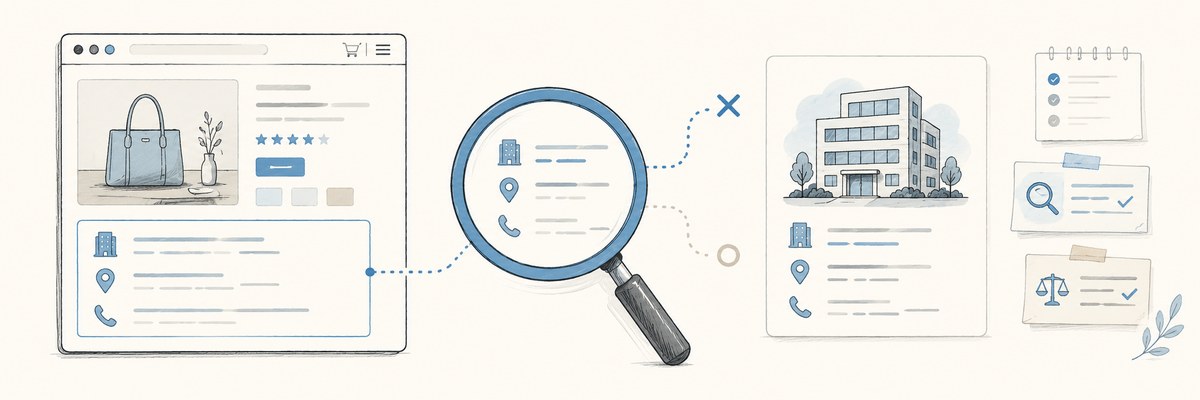
A company name, street address and phone number can be reassuring when you visit an unfamiliar online store.
But a company’s existence does not establish that it runs the store. A fraudulent shopping site may use the details of a real, unrelated business.
Real company details can be copied
Japan’s National Consumer Affairs Center warns that fraudulent shopping sites sometimes publish an unrelated business’s name, address and phone number without permission.
Finding the company in a search therefore does not finish the check.
The problem is not limited to empty contact sections or obviously implausible information. A site can present convincing company details neatly and clearly.
Look beyond the company profile
For a store you have not used before, check several things alongside whether the company exists:
- Find the company’s official website through a separate route, such as a search.
- Compare the shopping site’s URL with the URL on the official website.
- Compare the company name, address and phone number, and look for discrepancies that do not fit.
- Look for prices that are unusually low, or payment options that are oddly limited.
- Check the number of deliveries, the amount you will pay, and the return and cancellation terms.
Japan’s Consumer Affairs Agency and National Consumer Affairs Center both advise checking multiple details before buying, including URLs, contact information, prices, payment methods and language.
Matching names and addresses do not establish that a store is safe. A fake site can copy genuine information exactly.
Checking the company and checking the terms of the order are two separate jobs. Something you took for a one-off purchase can turn out to be a subscription, and the first delivery can be priced differently from the ones after it.
Japan’s Consumer Affairs Agency advises reading the final confirmation screen before you place the order, and checking the quantity and the price, when and how you pay, when the goods arrive, the return and cancellation terms, and any deadline for ordering. For details, see Consumer Affairs Agency: The final confirmation screen in mail-order sales (PDF, external site).
Company details are evidence to consider
The company profile is still worth reading.
Does it include a name, address and phone number? Does anything look inconsistent? Is there a connection to the company’s official website and URL?
Considering these details alongside prices, payment methods and return terms can help you notice things worth checking further.
Do not decide “safe” or “dangerous” from a single item.
Treat the company profile as one part of that check.
Additional detail: when company information is missing
In Japan, mail-order advertising generally has to display the seller’s name, address and phone number.
There are exceptions under specified conditions. These include stating that the required information will be provided without delay on request, and having arrangements to actually provide it. Here, “without delay” means giving the consumer enough time to consider the information before deciding to place an order.
Missing company information alone therefore does not establish that a site is illegal or fraudulent.
Additional detail: counting the published list
Legacy Tools checked the remarks for the 45 sites in the National Consumer Affairs Center’s published list of fraudulent shopping sites as of 17 June 2026. Of those, 27 had a note stating that the site displayed information belonging to a business unrelated to its operator.
This was Legacy Tools’ count of the list, not a percentage published by the Center. The list is not a comprehensive record of all fraudulent shopping sites.
Sources
- National Consumer Affairs Center: Warning about fraudulent shopping sites, including sites reusing marketplace images and wording (17 June 2026). See pages 2–3 and the appendix from page 8 of the report and list (PDF).
- National Consumer Affairs Center: Avoiding problems with fraudulent shopping sites.
- Consumer Affairs Agency: Beware of fake websites.
- Consumer Affairs Agency: Guide to the Act on Specified Commercial Transactions: mail-order advertising.
- Consumer Affairs Agency: Mail-order advertising Q&A, especially Q15 and Q17 on permitted omissions.
- Consumer Affairs Agency: The final confirmation screen in mail-order sales (leaflet, PDF; checked 14 September 2026).
- Consumer Affairs Agency: Guide to the Act on Specified Commercial Transactions: mail order (checked 14 September 2026).
All sources are external sites in Japanese; the English titles are descriptive translations. Except for the two with a stated check date, the originals were checked on 13 September 2026.